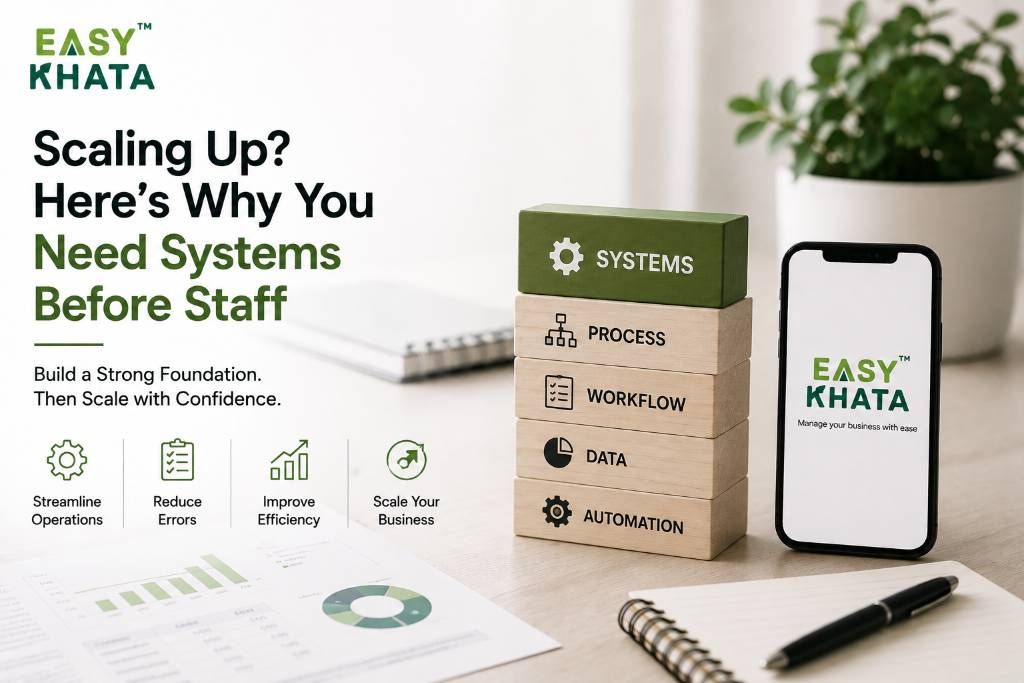
Growing a business is exciting.
More customers, more sales, more orders, and eventually, a bigger team.
But there is one mistake many growing businesses make: they add people before they build proper systems.
When business operations depend entirely on individuals, growth can quickly create confusion. More employees can mean more communication, more manual work, more chances of errors, and more difficulty keeping everyone on the same page.
Before adding more staff, businesses need a strong system that can support that growth.
1. Growth Brings More Complexity
When a business is small, the owner may personally handle billing, accounts, inventory, customer follow-ups, and employee management.
It may work when there are only a few transactions every day.
But as the business grows, managing everything manually becomes difficult.
More customers mean more invoices. More products mean more inventory records. More employees mean more attendance and payroll information.
Without proper systems, growth can increase workload instead of increasing efficiency.
2. Systems Create Consistency
A good system gives employees a clear way to perform everyday tasks.
Instead of one employee maintaining records in one format and another using a completely different method, processes can be organized and standardized.
This makes it easier to maintain consistency across billing, accounting, inventory, customer management, and other business activities.
A business shouldn't have to depend on one person simply because “only they know how to do it.”
3. Reduce Repetitive Manual Work
Before hiring additional employees, businesses should first identify which tasks are taking up unnecessary time.
Creating invoices, entering transactions, tracking payments, updating inventory, preparing reports, and maintaining customer records can involve repetitive work.
Digital business management tools can reduce some of this manual effort and allow existing employees to spend more time on tasks that actually require human attention.
4. Give Employees Better Access to Information
As teams grow, employees need access to the information required for their roles.
If important information is stored across notebooks, spreadsheets, personal devices, or individual systems, employees may spend more time searching for information than using it.
A centralized business system can help keep important records organized and accessible according to the business's requirements.
This can improve coordination and make day-to-day work smoother.
5. Keep Business Owners in Control
Scaling doesn't mean the owner should personally handle every task.
In fact, the opposite is true.
As a business grows, owners need to move away from constantly managing small operational tasks and spend more time on strategy, customers, growth, and decision-making.
A proper system can give business owners better visibility into areas such as sales, expenses, inventory, accounts, and employee-related activities.
This allows them to understand what is happening in the business without checking every transaction themselves.
6. Make New Employees Easier to Onboard
Hiring new employees becomes easier when there is already a defined process.
Instead of explaining every task from scratch, businesses can provide employees with an established workflow and the tools they need to follow it.
A structured system can help new team members understand how tasks are performed and where information needs to be recorded.
This becomes increasingly valuable as the team continues to grow.
7. Build a Business That Doesn't Depend on One Person
A scalable business should be able to continue operating even when one employee is unavailable.
If a business relies heavily on individual knowledge, someone's absence can create delays and confusion.
Systems help move important business information and processes from people's memory into structured workflows and records.
That's an important step toward building a business that can grow sustainably.
8. One System Can Bring Multiple Operations Together
As businesses expand, they often start using separate tools for different activities.
One tool for billing, another for accounting, another for inventory, and another for customer records can make operations complicated.
A unified business management platform can help bring important activities together.
Easy Khata offers features for accounting, GST, billing and invoicing, inventory, CRM and sales, payroll and HR, customer management, and other business operations.
Having these functions connected can make it easier for growing businesses to manage their daily activities from one platform.
Conclusion
Hiring more people can help a business grow, but people alone don't create scalability.
Systems create the foundation that allows people to work efficiently.
Before expanding your team, look at your current processes. Identify repetitive tasks, organize your records, standardize workflows, and introduce systems that can support your future growth.
Because the goal of scaling isn't simply to have more employees.
It's to build a business where more people can work together without creating more complexity.
With Easy Khata, businesses can bring essential operations such as accounting, billing, inventory, sales, CRM, and payroll together in one platform.
Build the system first. Then build the team around it.
📥 Download the Easy Khata Mobile App Today
Ready to manage your business anytime, anywhere?
👉 Download Now: https://easykhata.app/download
Empower your business with mobility, efficiency, and smart tools — only with Easy Khata.
📲 Follow Easy Khata on Social Media for More Tips & Business Tools
🔗 Instagram: https://www.instagram.com/easykhataapp/
🔗 Facebook: https://www.facebook.com/easykhata5
🔗LinkedIn: https://www.linkedin.com/showcase/easykhataapp/?viewAsMember=true